


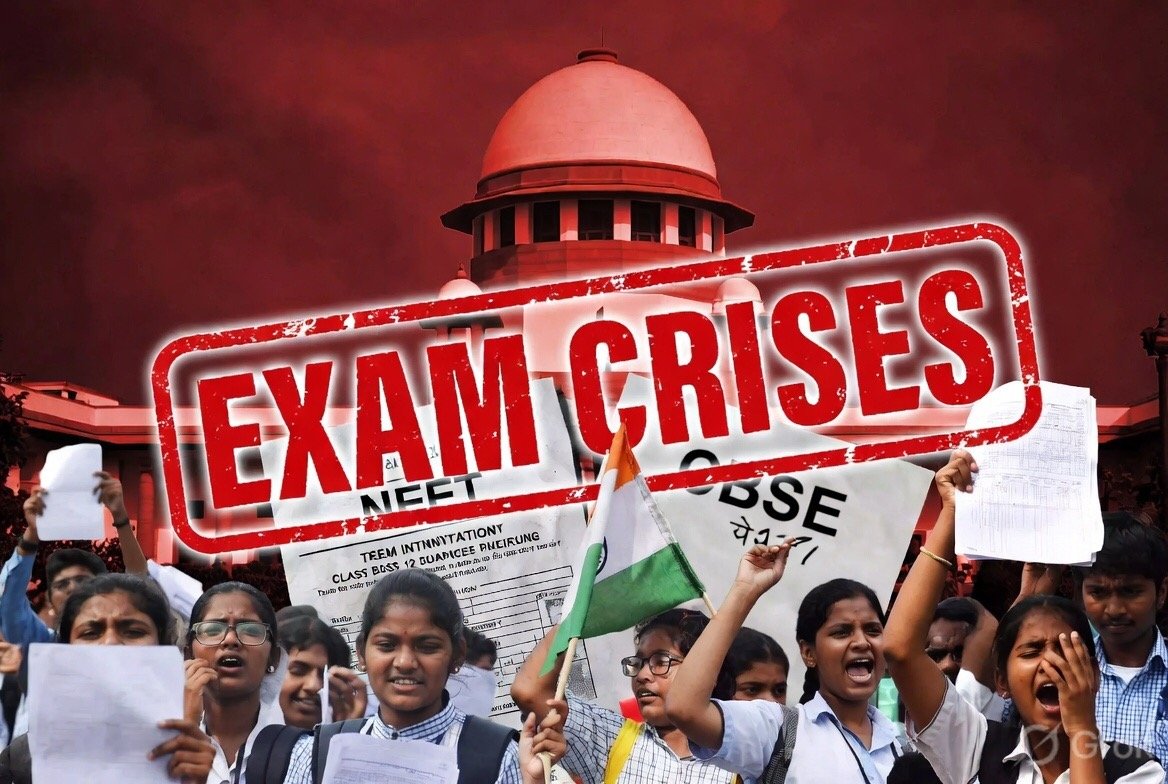






New Delhi: India’s examination system has been rocked by twin crises involving the cancellation of the NEET-UG 2026 medical entrance exam over a confirmed paper leak and widespread complaints of irregularities in CBSE Class 12 board exam evaluation, triggering student protests and demands for systemic reforms.

NEET is India’s national-level entrance examination for admission to undergraduate medical (MBBS) and dental (BDS) courses, conducted by the National Testing Agency (NTA) for over 22 lakh students annually. CBSE (Central Board of Secondary Education) is India’s premier national education board that conducts Class 10 and Class 12 board examinations for millions of high school students and oversees the curriculum in affiliated schools across the country.
Earlier this month, the National Testing Agency (NTA) cancelled the NEET-UG 2026 examination, held on May 3, on May 12 following credible evidence of a paper leak. A re-examination has been scheduled for June 21, 2026, with no additional fees and existing registrations carried forward.
CBI investigations have revealed a multi-state network allegedly involving insiders, including faculty from coaching hubs in Rajasthan, Maharashtra, and other states. A handwritten “guess paper” that circulated in Sikar showed significant overlaps with the actual question paper, news reports said. Arrests include teachers, intermediaries, and others, with the probe pointing to leaks through WhatsApp and Telegram groups.
Union Education Minister Dharmendra Pradhan, who has drawn massive flak for the crises, acknowledged lapses, stating the “command chain was breached” despite prior reforms recommended by the K. Radhakrishnan committee. He emphasised the government’s “zero tolerance” for the “education mafia” and announced plans to transition NEET to a computer-based format from 2027.
The Supreme Court has expressed concern over the recurring issues. A bench recently remarked that the NTA appeared not to have “learnt its lesson” from previous controversies and sought responses from the Centre on long-term reforms.
In parallel, the Central Board of Secondary Education (CBSE) faces backlash over its Class 12 results announced in mid-May. Thousands of students reported discrepancies under the new On-Screen Marking (OSM) system outsourced to a private vendor, including mismatched answer sheets, blurry scans, missing pages, and inconsistent evaluation. Over four lakh students applied for re-verification and copies of answer sheets.
CBSE has defended the process and engaged IIT experts for audits, while denying systemic failure. However, opposition leaders and parents have called for a judicial probe. The board had earlier issued strong warnings against fake paper leak rumours during the February-March 2026 exams.
Indian parents and students on social media have been pointing out that both crises highlight persistent vulnerabilities: over-reliance on physical question papers in high-stakes tests, influence of coaching cartels, and challenges in digital evaluation scaling. The NEET cancellation marks the first full scrapping of the exam in its history.
Pradhan assured Parliament and the public that foolproof measures, including enhanced coordination with state authorities and possible use of secure transport for future papers, would be implemented for the re-test. “We did not want any deserving student to be deprived,” he said.
As the CBI probe continues and the June 21 re-NEET approaches, the government is under pressure to restore credibility. Over 23 lakh students remain anxious about their academic timelines, with medical college admissions potentially delayed.

Political observers say the twin controversies could accelerate broader digitisation and stricter oversight of India’s competitive examination ecosystem.