


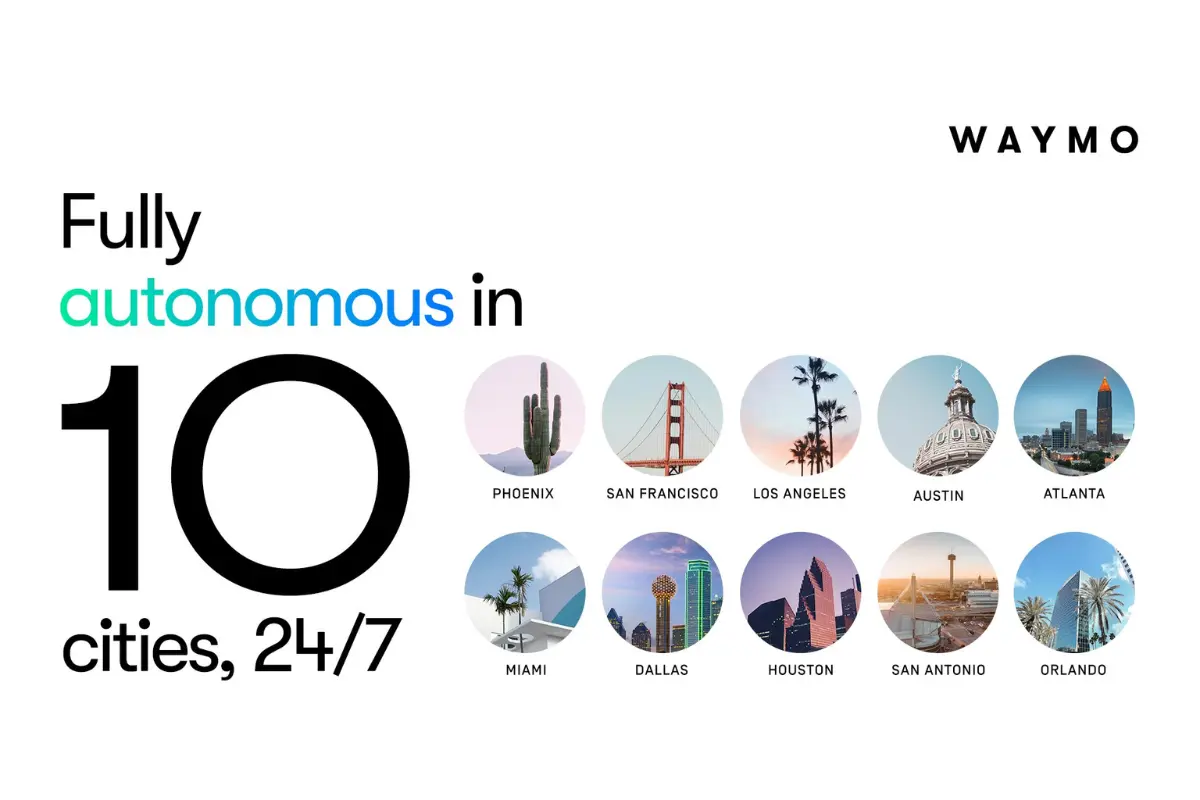






NEW DELHI / San Francisco, CA: Waymo, Alphabet Inc.’s autonomous driving unit, has dramatically expanded its fully driverless operations, doubling the number of U.S. cities where its robotaxi service operates without a human behind the wheel.

The company announced the official launch of fully autonomous driving in San Antonio and Orlando, bringing the total to 10 cities — a major milestone in the commercialization of autonomous vehicle technology.
Exponential scaling ongoing – @Waymo has officially doubled our fully autonomous cities in a matter of weeks, reaching 10 cities with the newest additions of San Antonio and Orlando. This is a testament to the maturity and generalizability of the Waymo Driver, our deliberate,… pic.twitter.com/004EPXIcA0
— Dmitri Dolgov (@dmitri_dolgov) December 12, 2025
Waymo Co‑CEO Dmitri Dolgov confirmed the achievement in a post on X (formerly Twitter), saying the rapid scaling is due to the maturity of the Waymo Driver system and a “deliberate, safety‑first approach” as the company prepares to serve more riders nationwide.
Expansion Across New Markets
This growth comes as part of Waymo’s broader plan to deploy its Level 4 autonomous driving system — meaning vehicles operate without a human driver in the seat — across more U.S. urban centers. According to Waymo’s official announcements, the company is introducing fully autonomous driving in:
-
Miami (already launched)
-
Dallas
-
Houston
-
San Antonio
-
Orlando
Operations in these new markets are rolling out progressively; Miami’s fully autonomous service has already begun, and the other cities will follow in the coming weeks, with public ride‑hailing expected to open more broadly in 2026.
In San Antonio, ongoing testing and mapping efforts have been observed across downtown and surrounding neighborhoods, even as local discussions surface about the safety and readiness of autonomous technology on city streets.
Waymo’s Growing Footprint and Transport Strategy
Waymo first began offering fully autonomous rides to the public in 2020 and has since steadily expanded its service footprint. Prior to this latest announcement, its robotaxis were operational — without safety drivers — in cities including San Francisco, Los Angeles, Phoenix, Austin, and Atlanta.
The company has also begun offering robotaxi service on freeway networks in multiple cities, a significant step that enables longer, higher‑speed autonomous trips and improves service efficiency.
Waymo’s service has seen robust usage growth. Internal investor letters and industry reports indicate it now completes hundreds of thousands of weekly paid rides, a substantial increase from earlier in 2025, and is targeting 1 million robotaxi rides per week by the end of 2026 as it expands to more cities, including international markets such as London and Tokyo.

Despite these advances, growth is unfolding amid scrutiny from regulators and communities. Recent reports cite incidents — including vehicles incorrectly passing stopped school buses — which Waymo is addressing via software updates and voluntary recalls.