


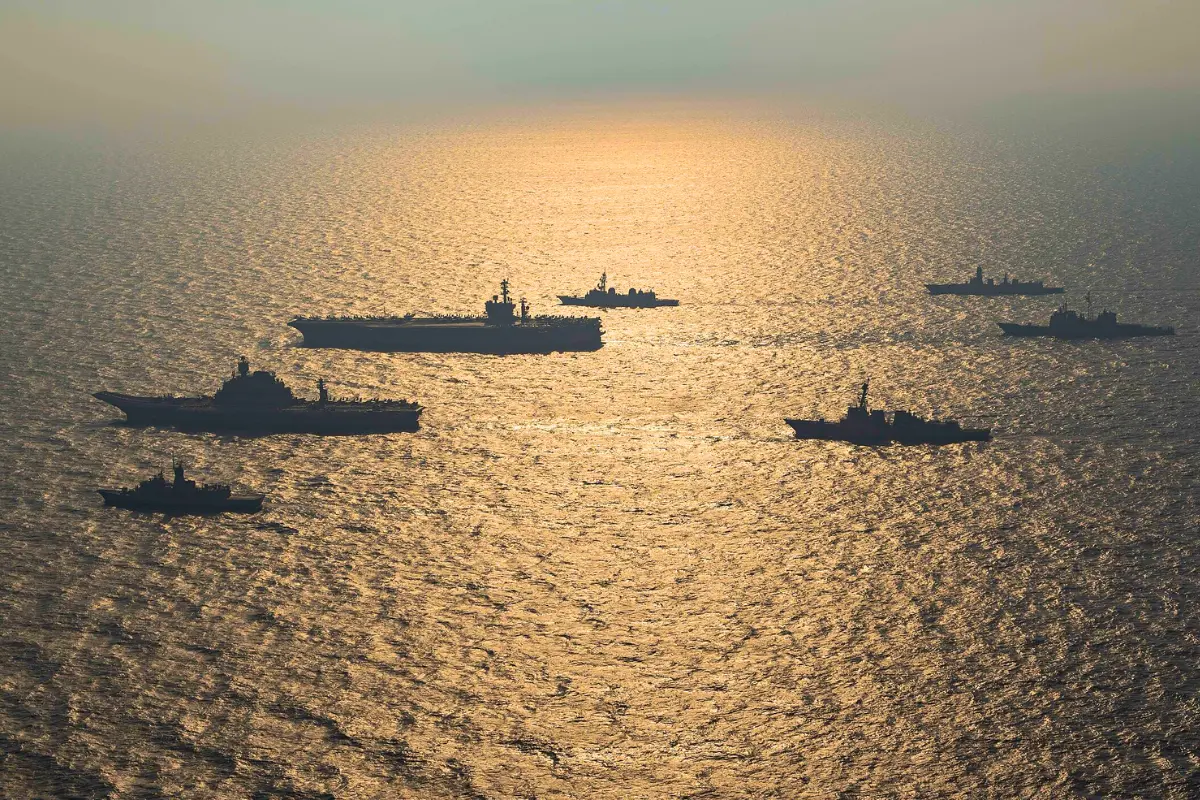






NEW DELHI: Naval forces from Australia, India, Japan, and the United States successfully concluded Exercise Malabar 2025, held November 10–18 in and around the island of Guam.

The multilateral maritime exercise focused on advancing operational coordination, high-end warfare training, and interoperability among the four Indo-Pacific partners.
This year marked the 29th edition of the Malabar exercise, which began in 1992 as a bilateral engagement between the United States and India.
The exercise has since expanded significantly in scope and complexity and now includes Japan and Australia, marking the sixth time all four nations trained together.
Strengthening Indo-Pacific Naval Cooperation
Exercise Malabar 2025 centered on joint tactical engagements including advanced maneuvering operations, anti-submarine warfare, anti-surface warfare, maritime domain awareness, information-sharing frameworks, and subject matter expert exchanges designed to strengthen combined maritime capabilities.
Expressing appreciation for the participating forces, Capt. Dave Huljack, commodore of Destroyer Squadron 15 (DESRON 15), said:
“I want to extend my deepest gratitude to everyone who planned and participated in Malabar 2025, especially our hosts in Guam. And a special thank you to our Australian, Indian, and Japanese friends. Over the past week, I have seen tremendous growth from our combined forces as they’ve been working side-by-side, learning from one another, and developing those person-to-person relationships. Your support and professionalism throughout this exercise were fully apparent and appreciated. Thank you.”
Key Assets Participating
Warships and aircraft from the four nations participated, including:
-
Royal Australian Navy – Anzac-class frigate HMAS Ballarat (FFH 155)
-
Indian Navy – Shivalik-class guided-missile stealth frigate INS Sahyadri (F 49)
-
Japan Maritime Self-Defense Force – Hyūga-class helicopter destroyer JS Hyūga (DDH 181)
-
United States Navy – USS Fitzgerald (DDG 62), a P-8A Poseidon, a U.S. submarine, and explosive ordnance disposal units under Commander, Task Forces 70, 72, 74, and 75
The United States led the 2025 exercise, continuing the annual rotation of planning leadership and venue among the participating countries, reinforcing the ability to operate across the Western Pacific and Indian Ocean regions.
Commitment to a Free and Open Indo-Pacific
The participating navies emphasized support for a stable maritime region. Joint exercises like Malabar remain central to safeguarding secure shipping lanes, deterring aggression and enabling rapid multilateral coordination.

U.S. 7th Fleet, which supported execution of the exercise, highlighted ongoing cooperation:
“Australian, Indian, Japanese, and U.S. maritime forces routinely operate together across the Indo-Pacific in support of regional security and stability.”