








NEW DELHI: The passing of the Online Gaming Bill, 2025 has sent shockwaves through India’s $20+ billion gaming industry. The new law bans all “online money games”—any digital game where players pay entry fees or stake money in expectation of winnings—regardless of whether the game is skill-based or chance-based.

The only exception is esports, which has been explicitly carved out as a recognised sport. But for fantasy sports platforms like Dream11, My11Circle, MPL, Zupee, the ban is existential. Not only can they no longer operate their core business, they also cannot advertise or sponsor sporting properties.
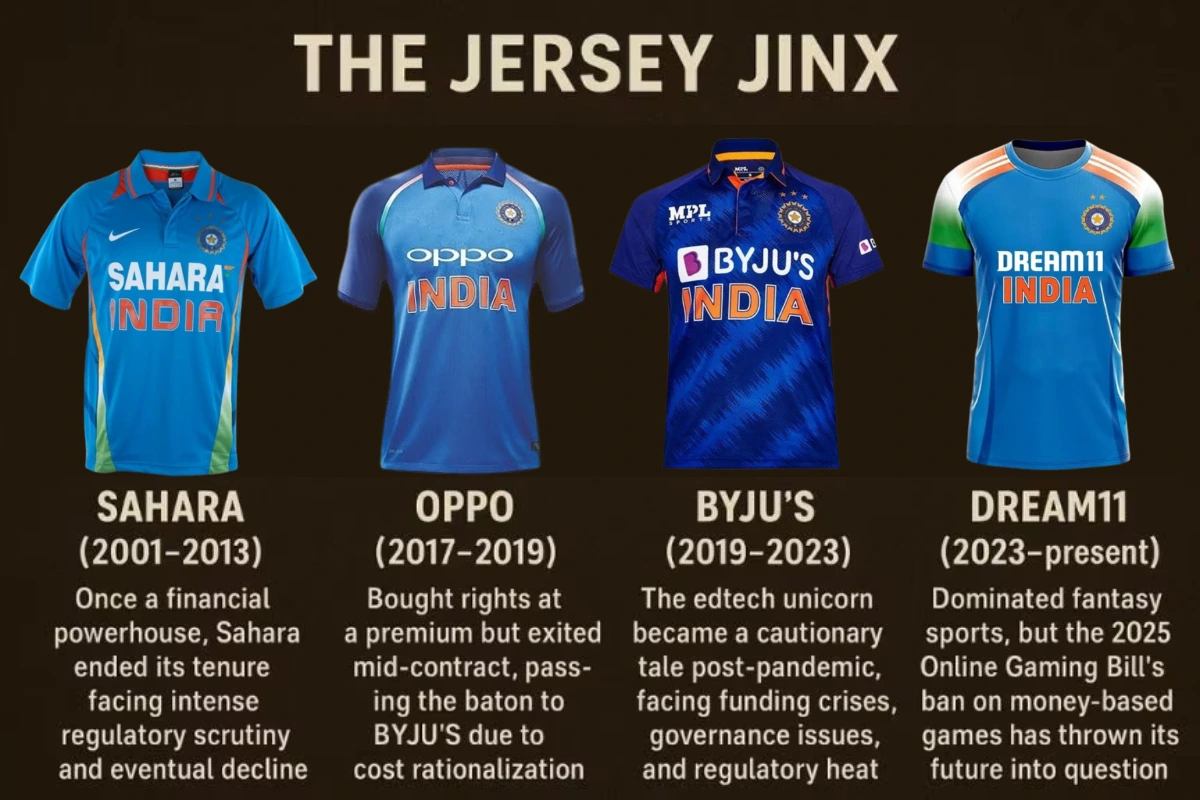
That has put the spotlight on Team India’s jersey sponsorship, where Dream11’s logo currently sits front and centre. With money-gaming ads now prohibited, the deal looks unsustainable. For fans, this feels like déjà vu: yet another jersey sponsor facing trouble. Which raises the question—is there a “jersey sponsor curse”?
The Sponsors Who Fell, One by One
Sahara (2001–2013)
For more than a decade, Sahara was synonymous with Indian cricket. But the group’s empire collapsed after regulators discovered it had raised thousands of crores through illegal debenture schemes. In 2011, SEBI and the Supreme Court ordered Sahara to return the funds. Its founder, Subrata Roy, was even jailed.
The curse begins—with compliance collapse.
Star India (2014–2017)
Star India stepped in after Sahara. Its tenure was smooth, ending with a routine exit once the next sponsorship cycle arrived.
The only sponsor to escape the “jinx.”
OPPO (2017–2019)
The Chinese smartphone giant splurged on sponsorship, but within two years realised the fees far outweighed the returns. In a rare move, OPPO transferred the contract mid-cycle to Byju’s, cutting its losses.
A premature exit driven by ROI discipline.
BYJU’S (2019–2023)
At the height of the pandemic, BYJU’S rode the edtech boom and became cricket’s new jersey sponsor. But cracks soon appeared: auditor resignations, mounting debt, layoffs, and multiple insolvency petitions. By 2023, the once-celebrated unicorn was in crisis and walked away from its sponsorship.
A meteoric rise followed by a steep fall.
Dream11 (2023 – Present)
Fantasy sports leader Dream11 took over, but quickly found itself in the government’s crosshairs. First came the 28% GST levy on real-money gaming in 2023, leading to massive retrospective tax demands. Now, in 2025, the Online Gaming Bill has outlawed its core business altogether, along with advertising and sponsorships.
The latest victim—felled by taxation and outright prohibition.
Is It Really a Curse?
At first glance, the sequence feels uncanny—every major sponsor except one has collapsed or exited early. But the deeper truth is this: the BCCI’s most valuable ad slot has consistently attracted brands from volatile, hype-driven sectors.
- Sahara → NBFC-style deposits, collapsed under legal action.
- OPPO → smartphone war chest, pulled out when ROI didn’t add up.
- BYJU’S → edtech bubble, burst under governance and debt pressure.
- Dream11 → real-money gaming, hit by GST New and Online Gaming Bill 2025 a complete ban.
- Star India → stable media brand, exited normally.
In other words, it isn’t a supernatural curse. It’s high-risk industries meeting high-visibility sponsorships.
- Dream11’s exit looks inevitable. With money-gaming ads banned, BCCI will likely issue a fresh tender for jersey sponsorship.
- New categories will step in. Experts expect FMCG, banking, insurance, telecom, and e-commerce giants—industries with deeper pockets and less regulatory risk—to dominate the next cycle.
- Esports could rise. With the Bill explicitly separating esports from gambling, publishers and event organisers may seize the opportunity to tie in with cricket, giving the sector mainstream legitimacy.
The so-called “jersey sponsor curse” makes for good headlines. But the truth is simpler: India’s cricket jersey has been rented out to boom-bust sectors chasing visibility, and when those bubbles burst, the crash plays out on cricket’s grandest stage.
Dream11 is just the latest name on the list. The real test will be whether the BCCI now turns to stable, long-term partners—or whether the “curse” will continue to claim more victims.