


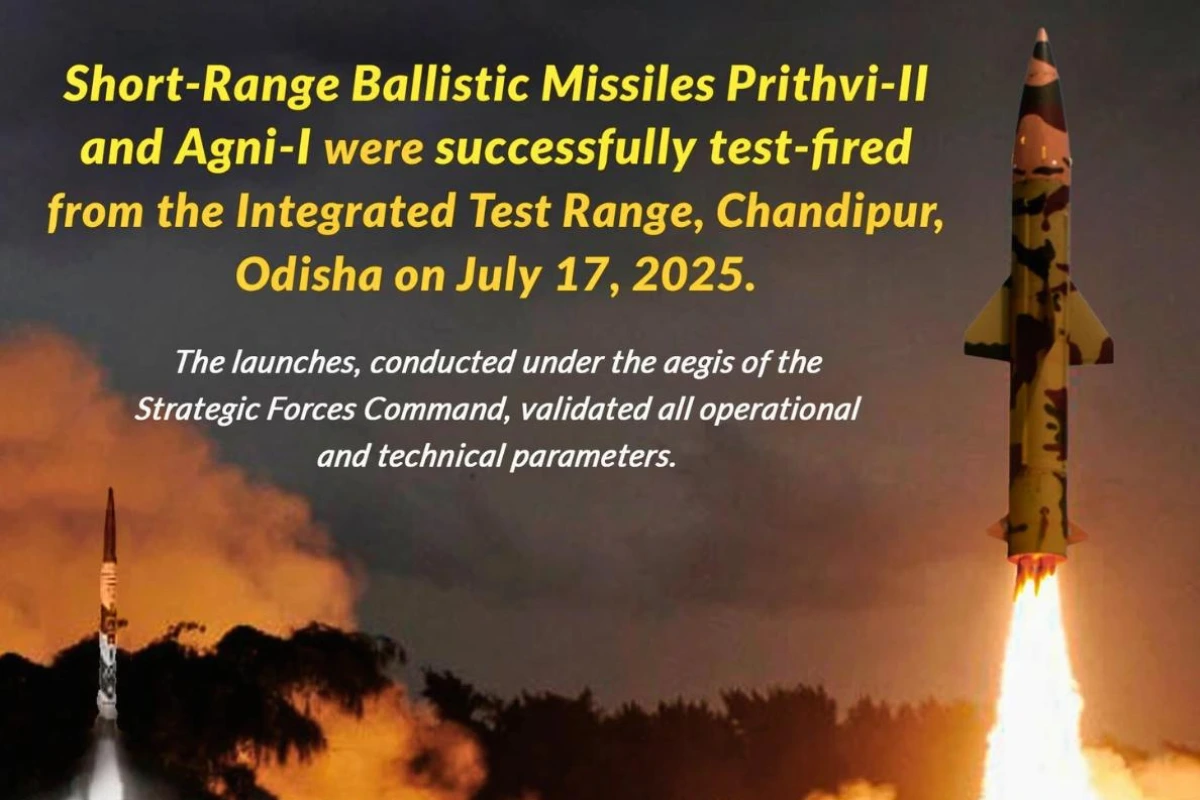






NEW DELHI: The Defence Research and Development Organisation (DRDO), in close coordination with the Strategic Forces Command (SFC), successfully conducted user training launches of two key short-range ballistic missiles—Prithvi-II and Agni-I—on July 17.

View this post on Instagram
The tests were carried out from the Integrated Test Range (ITR) located off the coast of Odisha at Chandipur, under actual operational conditions.
These successful launches are seen as a critical validation of India’s indigenous missile systems, which form a vital component of the country’s nuclear and conventional deterrence architecture.
The Ministry of Defence confirmed that both missile systems—developed by DRDO—achieved all mission objectives with precision. The flight paths of the missiles were closely monitored through tracking instruments such as radars, electro-optical sensors, and telemetry systems deployed by the ITR. These systems tracked the missiles’ trajectory in real-time, confirming that the launches proceeded in accordance with predetermined parameters related to range, accuracy, re-entry characteristics, and target precision.
The Prithvi-II is a short-range ballistic missile (SRBM) with a strike range of approximately 350 km. It is powered by a liquid-propellant twin-engine and is equipped with an advanced inertial guidance system and control system to achieve a high degree of accuracy.
First developed in the late 1980s under India’s Integrated Guided Missile Development Programme (IGMDP), the Prithvi series has been in operational service with the Indian Army and Air Force for several years. The Prithvi-II is capable of carrying both conventional and nuclear warheads and is known for its quick deployment readiness, making it a credible battlefield weapon.
The Agni-I missile, on the other hand, is the first missile in India’s prestigious Agni series and has a longer strike range of around 700 to 1,200 km. It is a single-stage, solid-fuel ballistic missile developed for swift deployment and high mobility. It fills the operational gap between the shorter-range Prithvi missiles and the longer-range Agni-II and Agni-III missiles.
Like Prithvi-II, Agni-I is also capable of delivering nuclear warheads and is an essential part of India’s tri-service Strategic Forces Command, which manages and operates the country’s nuclear arsenal in accordance with its “No First Use” doctrine.
View this post on Instagram
Defence analysts have noted that such user trials not only reaffirm the operational readiness of India’s missile arsenal but also provide valuable data for fine-tuning launch procedures, targeting accuracy, and overall system reliability under realistic conditions.
These tests are not part of developmental trials but operational launches carried out by trained personnel from the Strategic Forces Command, with DRDO acting as a facilitator. They underscore the Indian military’s ability to deploy and use these systems effectively if required.
The timing of these tests is also notable amid evolving regional security dynamics. With increasing geopolitical tensions in the Indo-Pacific and along India’s borders, the demonstration of credible, precise, and domestically developed missile systems sends a strong strategic signal. It underscores India’s focus on self-reliance in defense manufacturing and its ability to independently maintain a reliable deterrent posture against conventional and nuclear threats.
While both missiles are already inducted into the armed forces, periodic test launches are essential to validate system performance and crew readiness. These successful firings provide a morale boost to the Strategic Forces Command and affirm the reliability of DRDO’s indigenous missile systems.
ALSO READ: Fuel cut-off in both engines behind AI 171 crash; no pilot error but 4 MEL items under lens: AAIB
As India continues to modernize its armed forces and invest in new defense technologies, systems like Prithvi-II and Agni-I will remain central to its layered defense strategy.
The Ministry of Defence emphasized that both launches met “all operational and technical parameters,” further demonstrating India’s technological maturity in developing complex weapons platforms. The strategic community, including former defense officials and missile experts, has welcomed the tests as necessary steps in maintaining deterrent credibility, especially in an uncertain security environment.

As India enhances its nuclear delivery platforms across land, air, and sea-based systems, tests like these play a key role in strengthening its second-strike capability and reinforcing the doctrine of minimum credible deterrence. With advancements in missile guidance, propulsion, and re-entry vehicle technology, DRDO’s consistent performance has elevated India to the ranks of nations with robust, homegrown missile development and deployment capabilities