


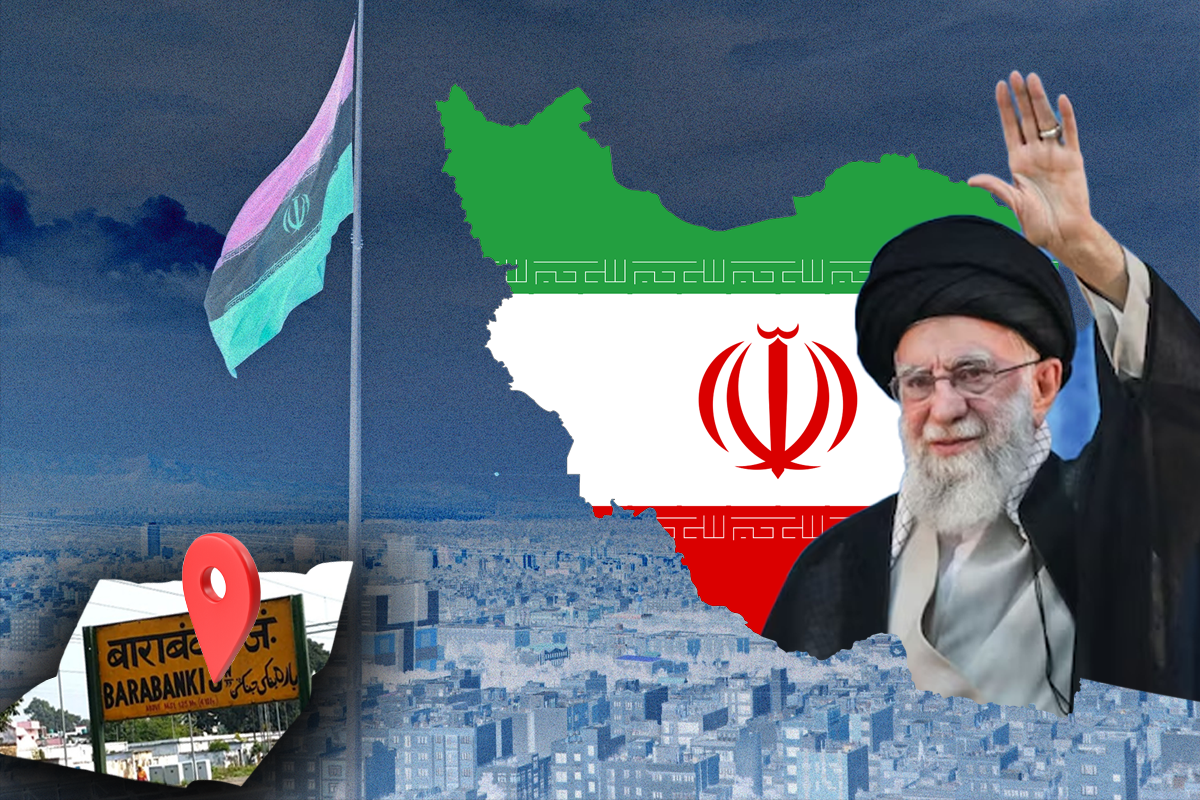






NEW DELHI: As Israel intensifies its military campaign against Iran, attention shifts to the towering figure of Iran’s Supreme Leader, Ayatollah Ali Khamenei. With his fiery rhetoric and unwavering stance, Khamenei has become the face of Iran’s defiance against foreign pressure. However, behind the political powerhouse that he is today lies an unexpected and largely unknown connection — a link to a small village in Uttar Pradesh, India.

Both Khamenei and his predecessor, Ayatollah Ruhollah Khomeini — the leader of the 1979 Islamic Revolution that overthrew the Shah of Iran — trace their roots back to a village called Kintoor, in Barabanki district, a few hours from Lucknow.
The Roots in India: Syed Ahmad Musavi Hindi
At the heart of this connection is Syed Ahmad Musavi Hindi, a Shia cleric born around 1800 in Kintoor. A descendant of Imam Musa al-Kazim, the seventh Imam in Shia Islam, Syed Ahmad’s upbringing was deeply steeped in religious tradition.
ALSO READ: Israel, Iran Trade Blows at Key Nuclear, Civil Sites
In 1830, Syed Ahmad moved to Najaf, Iraq, to visit the shrine of Imam Ali and eventually settled in Mashhad, Iran, where he became part of the religious elite. Despite his migration, he retained the surname “Hindi”, signifying his Indian origin. This name continued to appear in the official records of his descendants in Iran.
Khomeini’s Grandfather and His Influence
Syed Ahmad Musavi Hindi’s influence extended to his grandson, Ayatollah Ruhollah Khomeini. Born in 1902 in Khomein, Iran, Khomeini became the father of the Islamic Republic of Iran. His revolutionary ideas were shaped by his family’s legacy and their commitment to Shia Islam and Islamic revivalism. Khomeini led the 1979 revolution, which overthrew the Shah and ushered in the Islamic Republic.
His speeches, noted for their fiery delivery and hypnotic tone, mobilized millions, and his religious ideals — which had their roots in the teachings of his grandfather — shaped the new theocratic government. The CIA, in declassified reports, noted the role of Khomeini’s rhetoric in galvanizing Iran’s revolution.
Ali Khamenei: A Successor With Shared Roots
The current Supreme Leader of Iran, Ayatollah Ali Khamenei, is also a descendant of Syed Ahmad Musavi Hindi. Born in 1939 in Mashhad, Khamenei was raised in a religious household with a deep connection to the Shia tradition. His father, Sayyid Jawad Khamenei, was a scholar and a descendant of Syed Ahmad. Khamenei grew up in the city of Mashhad, a religious center for Shia Muslims, where he immersed himself in Islamic theology and revolutionary thought.
Though Khamenei has rarely spoken publicly about his Indian ancestry, some Iranian sources have acknowledged his roots in Kintoor, India. This connection, though understated, is part of the historical narrative of the Khamenei family’s rise within Iran’s religious and political spheres.
Kintoor: A Quiet Cradle of Shia Scholarship
Kintoor, once a flourishing center of Shia scholarship, continues to carry remnants of its past. The village houses imambargahs, the ancestral graves of the Sayyid families, and old manuscripts that highlight the intellectual and religious exchanges between India, Iraq, and Iran. The migration of Shia scholars from India to Iran was not unusual during the 18th and 19th centuries, and Syed Ahmad Musavi Hindi was part of this broader tradition of religious scholarship.
A Legacy Across Borders
The story of the Musavi family — from Kintoor in Uttar Pradesh to the halls of power in Tehran — underscores an important cultural and historical link between India and Iran. In today’s tense geopolitical climate, as Iran stands firm against external pressure, it’s fascinating to reflect on how these two world powers share a common past rooted in a small Indian village.
In a time when religious and political borders often divide nations, the shared heritage of Iran’s two most influential leaders serves as a reminder of the complex historical connections that shape the present.

Key Figures & Their Role in Iran:
| Figure | Birthplace | Key Link to India | Role in Iran |
| Syed Ahmad Musavi Hindi | Kintoor, Barabanki | Born in India, migrated to Iran | Ancestor, Shia cleric |
| Ayatollah Ruhollah Khomeini | Khomein, Iran | Grandson of Ahmad Hindi | Founder of Islamic Republic, 1st Supreme Leader |
| Ayatollah Ali Khamenei | Mashhad, Iran | Descendant of Ahmad Hindi | 2nd Supreme Leader of Iran |