


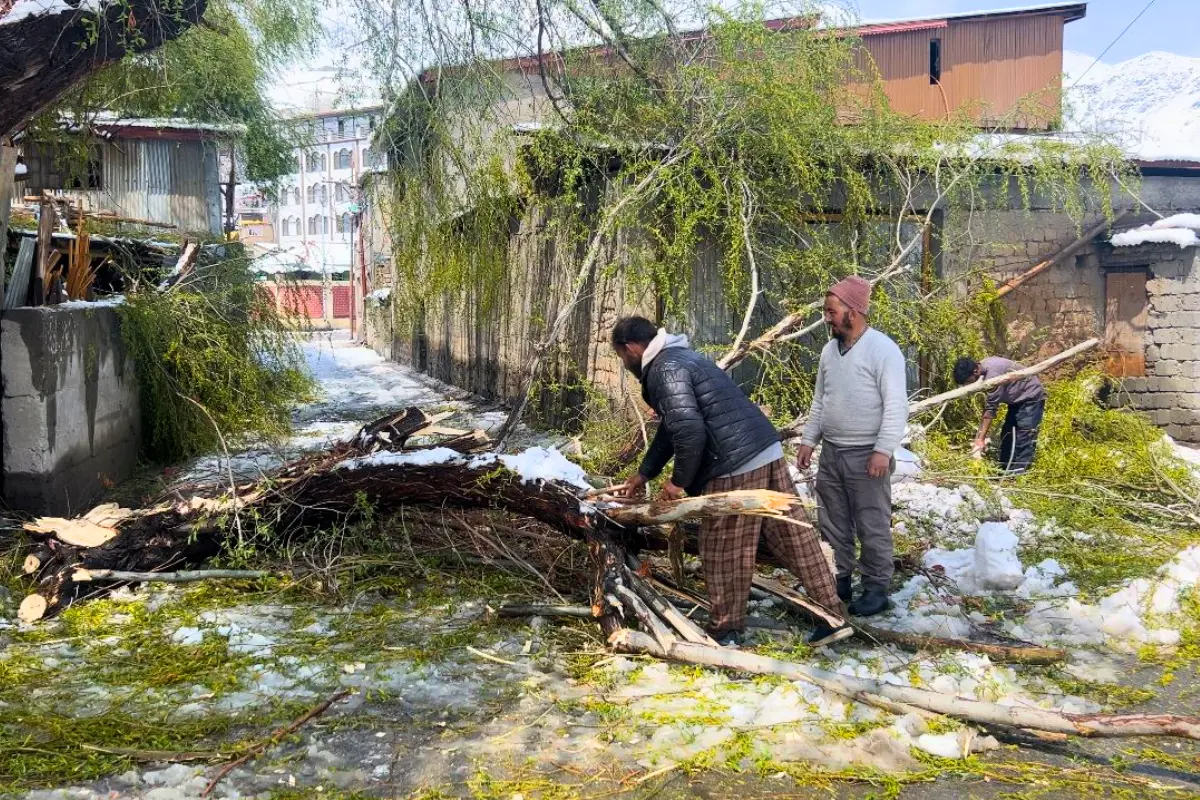






SRINAGAR: A sudden and intense snowfall blanketed large parts of Ladakh on Sunday, plunging daily life into disarray—particularly in Kargil district—at a time when the region was celebrating the vibrant apricot blossom season.

𝐖𝐞𝐚𝐭𝐡𝐞𝐫 𝐅𝐨𝐫𝐞𝐜𝐚𝐬𝐭/𝐖𝐀𝐑𝐍𝐈𝐍𝐆 𝐋𝐀𝐃𝐀𝐊𝐇
IMD issued Weather Warning for #Ladakh
Current widespread rain/snow across Ladakh likely to continue for nxt 24hrs. Gradual decrease in rain/snow likely from later tonight& overall improvement from 22nd
Stay 𝐀𝐥𝐞𝐫𝐭 pic.twitter.com/8nVYgxhc6v— METEOROLOGICAL CENTRE LEH-LADAKH (@metcentreleh) April 20, 2025
Heavy snow and relentless rainfall brought unexpected devastation to orchards and farm fields, severely hitting apple and apricot cultivation in villages like Hardass, Chanigund, Karkitchoo, and Badgam. Farmers across these areas are staring at major financial losses, as the untimely weather event has wiped out much of their seasonal yield.
The Meteorological Department had already issued a red-level weather alert, warning of significant rain and snowfall across the union territory. The warnings proved accurate, with the downpour beginning on April 19 and quickly disrupting the region’s fragile infrastructure.
Key transportation routes were choked. The Srinagar-Leh National Highway came to a standstill following major landslides near Lamayuru, while the Kargil-Zanskar road was pre-emptively sealed to ensure public safety. Electricity supply to multiple localities was knocked out, and fallen snow-covered trees created additional hazards, both to infrastructure and to people moving through affected zones.
Abdul Wahid, a Councillor with the Ladakh Autonomous Hill Development Council (LAHDC), Kargil, voiced serious concern over the extent of agricultural destruction. “The situation has hit our growers hard,” he said. “I’ve spoken with our Member of Parliament Muhammad Haneefa Jan, Chief Executive Councillor Muhammad Jaffer Akhoon, and the Deputy Commissioner of Kargil to speed up support for affected families.”
Acknowledging the crisis, LAHDC Chairman and Chief Executive Councillor Jaffer Akhoon convened an emergency strategy session with top officials from the Border Roads Organisation (BRO), local police, SDMs, municipal departments, and key representatives from horticulture, forest, health, education, and public works sectors.
In this high-level meeting, the Additional Deputy Commissioner was instructed to activate all departments to carry out immediate surveys of the damage—particularly in fruit farming, forest resources, irrigation channels, and drinking water systems. Akhoon stressed that all findings must be formally recorded under disaster management protocols so that proper compensation and aid can follow without bureaucratic delays.
To tackle rising water levels on roads, the NHIDCL was ordered to dispatch dewatering pumps urgently. Special directives were also given for stranded tourists in the Shakar Chiktan belt. The Sub-Divisional Magistrate of the area was told to ensure proper accommodation and hospitality for them during their unexpected stay.
Power restoration crews reported that major trunk lines in Kargil town were under repair and were expected to be functional by evening. Snow clearance machinery and ground teams from the Mechanical Department have been deployed across both main highways and inner village roads.
Emergency healthcare and essential services have been placed at the top of the restoration list. The administration urged residents to avoid travel unless necessary and to remain indoors until weather conditions improve.
As a preventive step, the Chief Education Officer (CEO) of Kargil directed the closure of all government and private schools for three days—April 21 to 23. The decision is aimed at safeguarding students and staff from unpredictable road conditions and further snowfall.
Meanwhile, the India Meteorological Department (IMD) has now downgraded its warning level to orange for April 20 and 21, indicating ongoing but slightly reduced risk of intense precipitation. It forecasts light snowfall at isolated locations before clearer skies return later in the week.
However, the IMD cautioned that the risk of avalanches, flash floods, landslides, and falling rocks remains high across several areas. Citizens, tourists, and officials have been strongly advised to exercise caution and, if possible, relocate to safer locations until the region stabilizes.
Local officials have confirmed that a comprehensive damage report will be compiled in the coming days once the weather allows for complete on-ground assessment.