


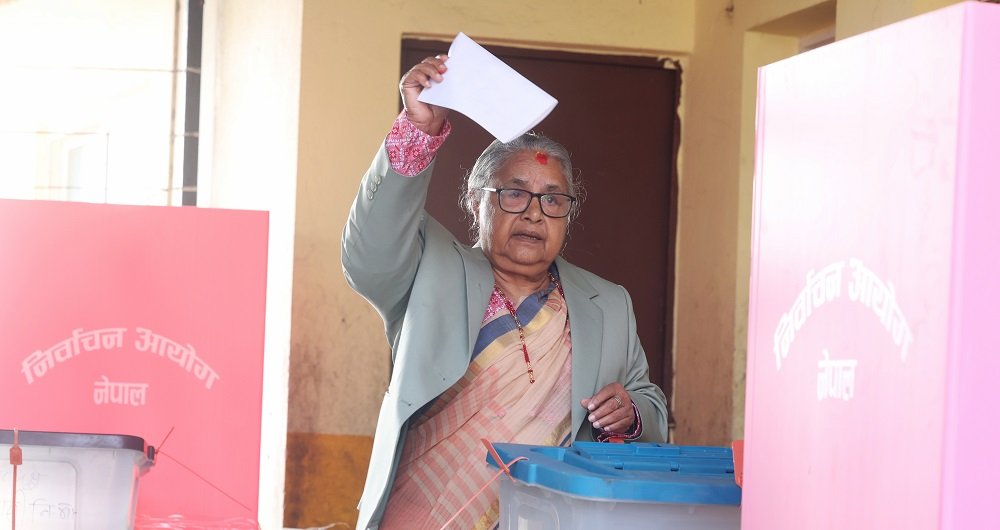






New Delhi: Nepal went to the polls on Thursday in a high-stakes general election to choose a new government, with nearly 19 million voters eligible to elect members to the country’s federal parliament, according to the Election Commission of Nepal.

Polling for the House of Representatives began at 7 a.m. local time and was scheduled to continue until 5 p.m. across the Himalayan nation, officials said. The election is being held to fill all 275 seats in the House of Representatives, the lower house of Nepal’s federal parliament.
The Election Commission said 18,903,689 voters were registered to participate in the election, an increase of more than 900,000 compared with the previous parliamentary vote held in 2022.
According to the Commission, the election follows a mixed electoral system provided under the Constitution of Nepal. Of the 275 members of parliament, 165 lawmakers are elected through the first-past-the-post system in single-member constituencies, while the remaining 110 seats are filled through proportional representation based on nationwide party votes.
Election called after political upheaval
The 2026 parliamentary election was called early after a period of political instability triggered by widespread anti-government protests in September 2025. The demonstrations, largely driven by youth and student groups, forced the resignation of then prime minister Khadga Prasad Sharma Oli, leading to the dissolution of the House of Representatives and the announcement of fresh elections.
Following the dissolution of parliament, an interim administration led by former chief justice Sushila Karki oversaw preparations for the election and governance during the transitional period.
Nepal’s President subsequently announced that parliamentary elections would be held on March 5, 2026, in accordance with constitutional provisions governing early elections.
Thousands of candidates contest
According to figures released by the Election Commission, 6,541 candidates are contesting the election. Of these, 3,406 candidates are competing under the first-past-the-post system, while 3,135 candidates are contesting under proportional representation lists submitted by political parties.
In the direct constituency races alone, 65 political parties have fielded 2,263 candidates, alongside 1,143 independent contenders seeking election to the 165 constituencies.
Overall, more than 68 political parties are participating in the election nationwide.
Election preparations and security
Nepal’s state-run newspaper The Rising Nepal reported that the Election Commission had completed all logistical preparations ahead of the vote. The Commission said election materials had been dispatched to 10,967 polling stations and 23,112 polling centres across the country, including 143 temporary polling centres established to facilitate voting.
Speaking at a press briefing on the eve of polling, Acting Chief Election Commissioner Ram Prasad Bhandari said the Commission was committed to conducting a “free, fair, transparent and credible” election in accordance with the constitution.
Officials also confirmed that security arrangements had been finalised nationwide to ensure a peaceful voting process. Authorities deployed large numbers of security personnel and coordinated operations between police, armed police units and the Nepal Army to protect polling stations.
Voting process and expected results
Polling stations opened across Nepal under tight security, with voters forming queues early in the morning to cast their ballots. Election officials said campaigning had ended earlier in the week and a mandatory silence period had been enforced ahead of voting day.
The Election Commission said vote counting would begin after ballot boxes are transported to designated counting centres once polling concludes. Preliminary results are expected within 24 hours of the completion of voting, according to the Commission.
A crucial vote for Nepal’s political future
The election is widely viewed as a critical test for Nepal’s democracy following months of political turbulence and calls for reforms from young voters and civil society groups.

The vote could reshape the balance of power between established parties and newer political movements emerging from the protest wave that shook the country last year.